
 By
By 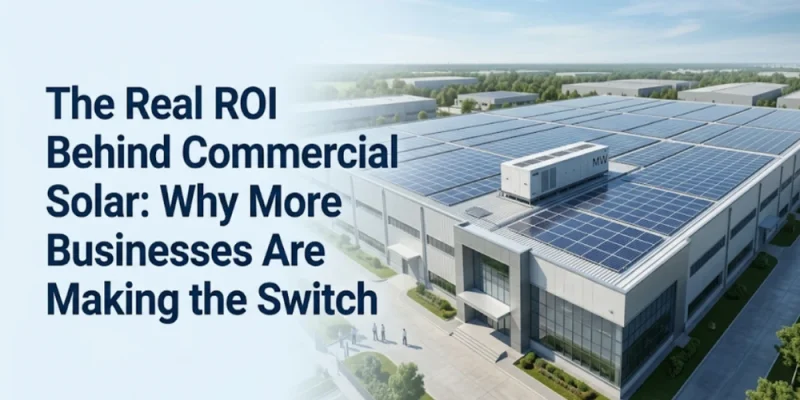
Sustainability used to be treated as a nice-to-have for businesses. These days, it’s become a genuine financial strategy, and commercial solar is at the center of that shift.
Why the Numbers Actually Work in Your Favour
Electricity is one of the few recurring costs a business can actually reduce through a one-time investment. For manufacturing units, warehouses, retail chains, and hospitality businesses in particular, energy bills eat into margins every single month, regardless of how well the business performs otherwise. Solar changes that equation by cutting the amount of power you need to buy from the grid.
Once installed, a commercial solar system can bring down electricity costs by 60 to 80 percent, sometimes more depending on system size and consumption patterns. Over a 25 to 30-year panel lifespan, that adds up to serious money, often running into crores for larger operations, with most businesses recovering their initial investment within 3 to 6 years.
What Return Can Be Expected
The typical annual return on investment that one may expect from commercial solar energy projects ranges between 15 and 25 percent, well ahead of many alternative business investments. Moreover, when taking into account tax implications, the figures turn out to be much more impressive. Indian companies have an opportunity to receive accelerated depreciation up to 40 percent during the first year of their solar energy investment in accordance with Section 32 of the Income Tax Act.
Energy Independence Is No Longer Optional
Grid reliability and tariff hikes have become real operational risks, not just background concerns. Solar reduces dependency on DISCOMs significantly, and when paired with a battery energy storage system, businesses gain something even more valuable: the ability to manage peak load demands and avoid disruptions entirely during outages. For sectors like manufacturing and IT, where even a short power interruption can be costly, this kind of energy security isn’t just convenient; it directly protects revenue.
There’s also a quieter financial benefit here through net metering, where surplus energy generated gets fed back to the grid in exchange for bill credits, adding another layer of savings over time.
Brand Value Perspective
Outside of the numbers, committing to going solar is a strong message that can be sent to clients, investors, and business partners. It has become more of a basic requirement than a differentiating factor to demonstrate environmental stewardship, particularly among young and environmentally-conscious consumers, and investors who actually prefer to do business with companies that practice environmental responsibility.
Which Industries Experience the Best Returns
Despite solar being viable in all kinds of industries, there are certain sectors that always return the quickest and the best results. Engineering and manufacturing plants profit from having constant and high energy consumption levels, which can be covered by solar energy. Warehouses and logistics centers are a great place to implement solar energy systems due to large rooftop surface area. Other examples include retail outlets, hospitals, schools, colleges, and food production units.
Getting the Execution Right Matters Just as Much as the Decision
A commercial solar project is only as good as the EPC solar company handling it. Site assessment, system design, procurement, installation, and ongoing performance monitoring all need to work together seamlessly for the numbers discussed here to actually materialise. Poor execution, whether it’s a badly designed layout or subpar components, quietly erodes the ROI that makes solar attractive in the first place.
This is where working with an experienced, end-to-end partner makes a real difference- someone who can handle everything from initial feasibility studies to financing guidance to post-installation support, including real-time performance monitoring through mobile and web dashboards.
Transitioning into Solar Energy
Solar energy is no longer the gamble of an emerging technology; rather, it is an intelligent choice that is justified not only by the profitability of investment but also by the tax benefits and energy security. Regardless of whether you operate a single warehouse or many retail outlets, the basic premise will be the same: faster payback periods and lower operating costs.
Waaree, a major photovoltaic solar products company with years of experience in manufacturing, offers its comprehensive assistance in implementing solar energy in businesses of all sizes through customized system design and installation, post-sale services, and technical support in all states of India.














Comments